
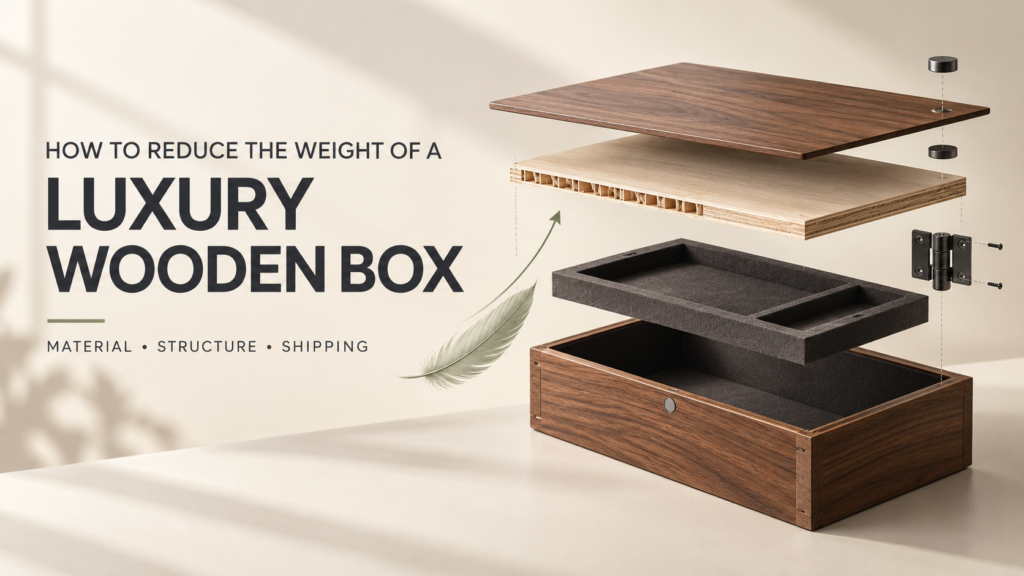
How to Reduce the Weight of a Luxury Wooden Box Without Losing Its Premium Feel
A luxury wooden box does not need to feel like a brick.
For wine, watches, jewelry, perfume, chocolate and collectible gifts, excessive packaging weight can increase material consumption, raise international shipping costs and make the finished product less convenient to handle.
The solution is not simply to replace hardwood with a cheaper material or make every panel thinner. A successful lightweight wooden box must balance five factors:
- Product protection
- Structural rigidity
- Shipping dimensions
- Premium appearance
- Material efficiency
The best results usually come from redesigning the entire packaging system—not from changing just one component.
Why Wooden Box Weight Matters More in 2026
European packaging requirements are putting more attention on material use, recyclability and unnecessary packaging volume.
The EU Packaging and Packaging Waste Regulation, or PPWR, generally began applying on August 12, 2026. It covers packaging regardless of material or origin and aims to reduce packaging waste and the use of primary raw materials. This means luxury packaging buyers increasingly need to explain why a box uses a particular amount of material, weight and internal space. [1]
Weight also affects logistics in two different ways:
- Actual weight: the physical weight of the product, wooden box, insert, accessories and shipping carton.
- Volumetric weight: the amount of transportation space occupied by the packed product.
For DHL Express shipments measured in centimeters and kilograms, volumetric weight is typically calculated as:
Length × Width × Height ÷ 5,000
The carrier normally compares volumetric weight with actual weight and charges according to the higher figure. Buyers should confirm the applicable divisor with their logistics provider because it can vary by carrier and service. [2]
Therefore, reducing only the wood weight may not lower freight costs if the shipping carton remains unnecessarily large.
1. Establish a Weight Target Before Designing the Box
Start with a weight budget for the complete packaging system.
The calculation should include:
- The product
- Wooden box body
- Lid and base
- Hinges, locks and magnets
- Decorative metal parts
- Interior insert
- Lining materials
- Accessories and documents
- Protective bag
- Export shipping carton
Ask the supplier to report both the empty box weight and the final packed weight.
A useful project brief might state:
Target empty box weight: to be confirmed after engineering review
Target shipping carton: no larger than 40 × 30 × 15 cm
Distribution method: international courier and retail delivery
Required function: presentation, protection and secondary storage
This gives the factory a measurable design objective instead of the vague instruction, “Please make it lighter.”
2. Reduce External Dimensions and Empty Space First
A smaller box can reduce wood, insert material and volumetric shipping weight at the same time.
Consider this simplified courier example:
| Shipping carton | Volumetric calculation | Volumetric weight |
|---|---|---|
| Original: 40 × 30 × 15 cm | 18,000 ÷ 5,000 | 3.60 kg |
| Optimized: 37 × 27 × 13 cm | 12,987 ÷ 5,000 | 2.60 kg |
Reducing only a few centimeters from each dimension lowers the calculated volumetric weight by approximately 28% in this example.
The actual shipping charge will still depend on the carrier’s rounding rules, service and comparison with actual weight.
To reduce dimensions safely, review:
- Space between the product and the box wall
- Clearance required for fingers to remove the product
- Insert thickness under and around the product
- Space occupied by manuals and accessories
- Decorative empty space that provides no protection
- Thickness of the outer shipping protection
Compact packaging should still feel intentional. The product should not look crowded or become difficult to remove.
3. Use Premium Wood Where Customers Can See and Touch It
Using thick solid hardwood for every panel is rarely the only way to achieve a premium appearance.
Depending on the product and design, a lighter structure may use:
- Real wood veneer over an engineered panel
- Thin plywood panels with reinforced solid-wood edges
- A lightweight panel with hardwood corner blocks
- Solid wood around hinges, locks and high-load areas
- Veneered panels combined with an internal frame
- Local reinforcement instead of full-panel thickness
This creates a simple engineering principle:
Put material where the structure carries load, and put premium wood where the customer experiences it.
Wood density varies significantly between species. USDA Forest Products Laboratory data show that the density of commercial woods can range from approximately 320 to 881 kg/m³, depending on species and moisture condition. [3]
This means two boxes with identical dimensions can have very different weights.
However, a lower-density wood is not automatically the best choice. The factory must also consider:
- Screw-holding strength
- Surface hardness
- Machining quality
- Grain appearance
- Paint absorption
- Dimensional stability
- Availability and batch consistency
MDF should not automatically be described as a lightweight alternative. Depending on its density and thickness, an MDF panel may weigh more than a carefully selected plywood or lower-density wood structure.
Material descriptions must also remain accurate. A veneered box should not be marketed as a solid walnut, oak or maple box.
4. Reduce Panel Thickness Selectively
Panel mass generally changes in proportion to panel thickness when material density and surface area remain the same.
Consider a simplified rectangular wooden shell measuring 360 × 260 × 120 mm. Its approximate external panel area is 0.336 m².
Using a material density of 650 kg/m³:
| Panel thickness | Approximate panel mass |
|---|---|
| 10 mm | 2.18 kg |
| 7 mm | 1.53 kg |
Reducing the thickness from 10 mm to 7 mm produces a theoretical panel-material saving of about 0.66 kg, or 30%.
This is an illustrative calculation. Actual box weight will also include joints, cutouts, inserts, lining and hardware.
The safest approach is not to reduce every panel equally. A factory can retain additional material in:
- Hinge mounting areas
- Lock and magnet positions
- Bottle support points
- Load-bearing bases
- Corners exposed to impact
- Large lids vulnerable to twisting
Less critical side panels may then be reduced or replaced with framed panels.
5. Redesign the Interior Insert
The insert can become one of the heaviest hidden components in premium packaging.
Thick foam is often added to create a substantial appearance, even when much of it provides no additional protection. A better insert is designed around the product’s real load points.
For different products, this may mean:
- Wine and spirits: support the bottle base, shoulder and neck.
- Watches: secure the cushion while preventing contact with the crystal, crown and bracelet.
- Jewelry: control movement and prevent surface abrasion.
- Perfume: protect the bottle base, cap and vulnerable glass corners.
- Chocolate: use an appropriate food-contact inner system with efficient compartment spacing.
Possible lightweight insert approaches include engineered paperboard structures, molded pulp, shaped lightweight foam or hybrid inserts. The final material depends on product value, fragility, presentation and applicable compliance requirements.
A lighter insert is only successful when the product remains stable during handling and transportation.
6. Right-Size the Hardware
Oversized hinges, metal locks, plaques and magnets can add more weight than expected.
Review every hardware component according to its function:
- Can a smaller hinge carry the lid?
- Are four magnets necessary when two can provide sufficient closure?
- Can a thick metal logo plate become a thinner plate or laser engraving?
- Does the lock add security, or is it mainly decorative?
- Can the hardware be concentrated around reinforced areas?
Hardware optimization must be followed by opening-and-closing cycle tests. A lighter hinge that becomes loose after repeated use is not an improvement.
7. Remove Decorative Weight That Adds Little Value
Luxury should come from execution, not unnecessary mass.
Common sources of decorative weight include:
- Thick glass windows
- Large metal plaques
- Multiple decorative panels
- Heavy leather wrapping
- Oversized accessories
- Deep bases with unused internal space
- Double lids or unnecessary secondary compartments
These elements can sometimes be replaced by:
- Laser engraving
- Thin metal branding
- Printed or patterned wood veneer
- Controlled color matching
- Cleaner opening lines
- Better grain selection
- More precise inserts
A well-aligned lid, consistent finish and precise product fit often communicate more quality than a heavy decorative component.
8. Validate the Lightweight Design Before Mass Production
Removing material without testing can lead to cracked corners, loose hinges, lid distortion or product movement.
ISTA packaging procedures may include vibration, drop, compression and atmospheric conditioning, depending on the distribution environment and selected test protocol. [4]
A practical development process should compare at least two prototypes:
| Prototype | Purpose |
|---|---|
| Reference sample | Original structure and visual standard |
| Lightweight sample | Reduced material, thickness or dimensions |
Compare the following:
- Empty box weight
- Final packed weight
- Shipping carton dimensions
- Lid alignment
- Corner rigidity
- Hinge and lock performance
- Product movement
- Drop and vibration performance
- Temperature and humidity response
- Surface abrasion
- Final appearance
If the lightweight sample fails, do not automatically return to the original heavy design. Identify the failure point and reinforce that specific area.
What Should Not Be Reduced First?
Some components directly protect the product or maintain structural stability.
Avoid reducing these areas without engineering review:
- Bottle base support
- Hinge anchoring points
- Large lid frames
- Corner joints
- Glass-product clearance
- Watch and jewelry contact protection
- Areas carrying locks or handles
- Export carton corner protection
The objective is material efficiency—not minimum possible weight.
Lightweight Wooden Box RFQ Checklist
Before requesting a quotation, give the factory the following information:
- Product dimensions and weight
- Product photos or 3D files
- Target box dimensions
- Preferred wood appearance
- Maximum empty box weight, if available
- Target sales and shipping markets
- Distribution method
- Required insert and accessories
- Expected order quantity
- Required sustainability documentation
- Testing expectations
- Whether the box will be reused after unboxing
This information allows the supplier to evaluate structure, materials and production feasibility before sampling.
Frequently Asked Questions
How much weight can be removed from a wooden box?
There is no universal percentage. Savings depend on the original structure, wood density, panel thickness, hardware, insert and shipping dimensions. For example, reducing a panel from 10 mm to 7 mm theoretically reduces that panel’s material mass by 30%, but the percentage for the complete box will be lower because hardware and inserts remain.
Is plywood always lighter than solid wood?
No. Weight depends on density and thickness. Some engineered panels are dense, while some solid woods are comparatively light. Buyers should request the calculated material weight and the measured weight of the finished prototype.
Can wood veneer still look luxurious?
Yes. Premium appearance depends on veneer quality, grain matching, edge treatment, surface preparation, finish consistency and structural rigidity. The material should be described honestly in product and sustainability documentation.
Will a lightweight box feel cheap?
Not if the design retains rigidity, clean joints, controlled opening resistance, precise product fit and a refined finish. Customers usually notice poor execution before they notice reduced panel thickness.
Can a lighter box still protect a wine bottle or watch?
Yes, provided that material is retained around critical load and contact points. Packaging performance should be validated against the actual product and intended distribution environment.
Does the EU PPWR prohibit heavy wooden boxes?
The regulation does not create one universal weight limit for every wooden gift box. However, it increases the importance of packaging minimization, recyclability and technical documentation. Brands should assess the applicable requirements for their product and target market.
Conclusion
The most effective lightweight wooden box is not simply thinner. It is more intelligently engineered.
Start by reducing unnecessary dimensions, then select the appropriate wood structure, reinforce only the critical areas, optimize the insert and hardware, and validate the complete pack through testing.
Planning a lighter custom wooden box for wine, watches, jewelry, perfume, chocolate or premium gifts?
Share your product dimensions, target market, order quantity and packaging requirements with Samding Wooden Box Factory. Our team can help evaluate the structure, material, insert and prototype before mass production.