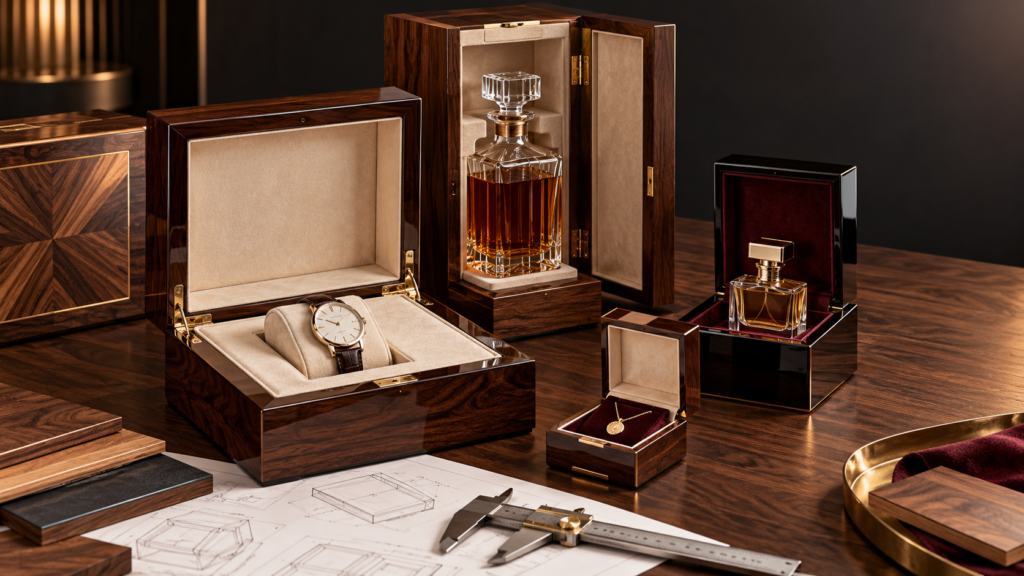
Luxury wooden packaging succeeds when structure, finish, insert, sustainability and production repeatability are specified together. This guide maps watches, jewelry, wine, spirits and perfume packaging to the right wooden-box construction—with the details buyers should lock before requesting mass production.
By Samding Packaging Engineering Team
Industry examples in this article are public packaging references. They do not imply that the brands mentioned are Samding clients or that Samding manufactured their packaging.
On this page
- Why luxury wooden packaging fails before the finish does
- Matching wooden-box constructions to product categories
- Limited editions: when complex design must survive production
- Watches and jewelry: close-range precision changes the brief
- Wine and spirits: protection and ceremony must work together
- Sustainability: lower impact without losing perceived value
- What to lock before you place the order
- How Samding supports luxury packaging programs
- Bottom line
Quick answer: A luxury wooden box should not be specified only by its dimensions, wood species or appearance. Buyers also need to define structural tolerances, surface-finish standards, insert performance, opening resistance, approved materials, quality limits and how the supplier will reproduce the approved sample during mass production.
The right solution depends on the product. A watch box needs precise fit and close-range finish quality; a whisky box must control bottle weight and movement; perfume packaging must protect fragile glass; and a limited edition may require complex assembly, numbering or digital traceability.
Why luxury wooden packaging fails before the finish does
Many packaging projects treat the wooden box as a styling exercise. In production, however, most failures begin with an incomplete technical brief.
A beautiful rendering cannot define hinge resistance, veneer direction, acceptable lid gaps or how much movement is allowed inside the insert. If those details remain open to interpretation, two boxes can look similar in a presentation but perform very differently in the customer’s hands.
The three failure points to design out before sampling are:
- Structure mismatch — The box looks correct but does not account for product weight, centre of gravity, shipping orientation or repeated opening.
- Finish mismatch — The sample is approved visually, but colour, gloss, grain direction and surface defects have no measurable acceptance standard for bulk production.
- Evidence mismatch — Sustainability or sourcing terms appear in the brief, but the required certificates, material records and permitted environmental claims are not defined.
The purpose of a detailed specification is not to restrict creativity. It is to protect the original design intent when the project moves from one handmade sample to hundreds or thousands of finished boxes.
Matching wooden-box constructions to product categories
| Product category | Recommended construction | Main packaging job | What fails first when under-specified |
|---|---|---|---|
| Single luxury watch | Compact hinged or lift-off wooden box with fitted cushion or removable travel pouch | Protect the watch while keeping the presentation compact | Loose cushion, excessive box weight or incorrect pressure on the strap |
| Watch collection | Multi-compartment presentation or storage box with stable dividers and lined trays | Organize multiple pieces and support repeated use | Uneven compartments, tray movement or inconsistent lid alignment |
| Fine jewelry | Veneered, painted or wrapped wooden box with soft-touch precision insert | Hold small products securely under close inspection | Misaligned logo, visible glue, surface dust or jewelry movement |
| Premium spirits | Reinforced hinged, double-door or lift-off box with bottle-specific cradle | Protect a heavy glass bottle and create a ceremonial opening | Bottle movement, overloaded hinges or insert deformation |
| Luxury perfume | Compact lacquered or veneered box with shaped support for the bottle base and shoulders | Protect fragile glass while improving shelf and gift presentation | Scuffing, colour mismatch or poor insert fit |
| Limited-edition gift set | Bespoke structure with several components, accessories or numbered elements | Turn the packaging into a collectible brand object | Tolerance accumulation, assembly inconsistency or incorrect serialisation |
This table is a starting point, not a substitute for product data. Final construction should follow the product’s dimensions, weight, fragility, distribution route and intended customer experience.
Limited editions: when complex design must survive production
Limited-edition packaging often carries the strongest creative idea—and the highest production risk.
The Macallan’s TIME : SPACE Mastery presentation uses a bespoke box with 200 carefully crafted spikes. Rémy Martin’s 300th-anniversary presentation pairs a wooden case with a Cellar Master’s note and a unique QR code. These public examples show how luxury packaging can combine sculptural design, storytelling and digital content.
The manufacturing question is not simply, “Can the supplier make one?”
The better question is, “Can the supplier reproduce the same visual rhythm, fit and opening experience throughout the approved production quantity?”
For complex projects, lock these decisions early:
- Identify the dimensions and surfaces that are critical to the design.
- Select a stable substrate before deciding veneer, paint or decorative layers.
- Evaluate tolerances in the fully assembled box, not only on individual parts.
- Define the assembly order for hardware, inserts, logos and decorative components.
- Complete a pilot run before releasing the entire production quantity.
- Record numbered plaques, QR codes or certificates against the correct finished box.
Decorative woodworking also needs a reference that production teams can inspect. For example, Samding’s H-Style Parquet Storage Box combines a piano-style wood finish, marquetry on the lid and a suede-lined divided interior. For this type of construction, grain direction, pattern alignment, coating depth and divider position should all be part of the approval standard.
Watches and jewelry: close-range precision changes the brief
Watch and jewelry packaging is handled and examined at close distance. Small defects that might disappear on a large shipping case become obvious under boutique lighting or in product photography.
The critical specifications normally include:
- Lid-to-base gap and alignment
- Hinge position and opening resistance
- Magnet strength and closing sound
- Cushion compression and product retention
- Lining colour, texture, seams and adhesive control
- Logo size, position and edge definition
- Scratch, dust and fingerprint acceptance limits
- Consistency between different box sizes in the same collection
The insert should be engineered around the actual watch, bracelet, ring, necklace or accessory—not around a generic cavity. It must hold the product securely without placing unnecessary pressure on straps, clasps, stones or polished surfaces.
For category examples, review Samding’s custom watch boxes and collection packaging and custom wooden jewelry boxes. A satin-finish jewelry-box example also shows how a mirror, lined interior, tray, hardware and exterior finish must work as one system.
Weight is another design decision. A heavier box does not automatically feel more luxurious. Compact construction, balanced opening resistance and a well-engineered interior can create a stronger experience with less material.
Wine and spirits: protection and ceremony must work together
A premium wine or spirits box has two simultaneous jobs: it must manage a heavy glass bottle during transport, and it must create a controlled reveal when opened.
The specification should begin with the filled bottle—not only the empty bottle drawing. Record its total weight, widest diameter, shoulder profile, closure height and centre of gravity.
Four decisions usually determine performance:
1. Bottle retention
The bottle should not rattle, rotate or place concentrated pressure on a fragile decorative area. Upper and lower supports must work together rather than relying on one tight cavity.
2. Hardware loading
Large lids and double doors put additional stress on hinges, magnets and locks. Hardware should be tested with the complete assembled box and bottle weight.
3. Opening orientation
The customer should immediately understand how to access the bottle. Ribbons, finger spaces and removable wedges must remain usable without weakening the presentation.
4. Distribution protection
A presentation insert is not automatically a shipping insert. If the wooden box will travel through parcel or export distribution, the complete pack-out needs an appropriate test plan.
Samding’s custom wine and spirits boxes show different approaches to reinforced structures, fitted bottle supports and decorative finishes. Relevant construction examples include an oak-veneer whisky presentation box and a veneered beverage box with fitted bottle wedges.
The important comparison is not which box appears most elaborate. It is which construction supports the product, brand position, shipping method and production quantity with the fewest uncontrolled variables.
Sustainability: lower impact without losing perceived value
Luxury brands increasingly expect packaging suppliers to reduce unnecessary material while preserving protection and presentation.
Public watch-industry examples illustrate this direction. IWC states that its redesigned packaging uses 30% less material and 90% less plastic than its previous version. Panerai reports packaging made with at least 72% post-consumer recycled material that is 53% lighter than its previous packaging.
For wooden packaging, the same principle means asking more precise questions:
- Can the outer dimensions be reduced without affecting protection?
- Can the insert use fewer materials or easier-to-separate components?
- Can a removable tray or pouch give the box a useful second life?
- Can decorative plastic parts be replaced or eliminated?
- Is the box designed for repair, reuse or long-term display?
- Can the supplier provide the material and sourcing records required by the brand?
FSC is not simply a material name. A finished product carrying an FSC claim must follow the relevant chain-of-custody requirements through the supply chain.
For EU-bound projects, packaging requirements also deserve early review. Regulation (EU) 2025/40 on packaging and packaging waste begins applying in phases from 12 August 2026, increasing the importance of packaging reduction, recyclability and documented material decisions.
Before making a sustainability claim, ask the supplier for:
- A material bill of materials
- FSC or other requested sourcing documentation
- Approximate material weights
- Identification of plastics, magnets and metal hardware
- Separation or disposal instructions where relevant
- Written confirmation of which environmental claims can be supported
The strongest result is not a box that merely looks “natural.” It is a packaging system whose materials, construction and claims can be verified.
What to lock before you place the order
- Product data
Provide final dimensions, filled weight, fragile surfaces, centre of gravity and any accessories included in the set. - Distribution route
Confirm whether the box will be used for boutique collection, e-commerce, international shipping, gifting or long-term storage. - Structure and tolerances
Approve drawings showing external dimensions, internal clearances, lid gaps, insert fit, hardware positions and opening angle. - Finish master
Keep an approved physical standard for colour, gloss, grain direction, texture, logo treatment and acceptable natural variation. - Insert performance
Test the insert using actual production products. Confirm retention, pressure points, abrasion risk, removal method and material odour. - Sample stages
Separate structural sampling from the final appearance sample when the project uses complex lacquer, veneer, marquetry or custom hardware. - Quality plan
Define inspection points, acceptable defect limits, functional tests, packaging protection and how non-conforming units will be handled. - Change control and traceability
Require written approval before changes to material, colour, hardware, insert density, subcontracted processes or digital identifiers.
A sample should not be approved only because it “looks good.” Approval should create a production standard that both the brand and manufacturer can inspect.
How Samding supports luxury packaging programs
Samding is a custom wooden packaging manufacturer based in Dongguan, China. The company states that it has produced premium wooden packaging since 1999, covering watches, jewelry, wine and spirits, perfume, chocolate and gift sets. Its published workflow includes material preparation, cutting, assembly, painting, logo application, packing and quality control.
For luxury packaging projects, Samding can support three common development routes:
- Concept-to-sample development — Start with a product, reference image or design concept, then translate it into a practical structure, insert and finish specification.
- OEM and ODM production — Develop custom constructions for watch packaging, wine and spirits boxes, jewelry boxes, perfume boxes and gift packaging.
- Surface and production engineering — Coordinate woodworking, sanding, veneer or marquetry, paint and lacquer, logo decoration, interior lining, hardware assembly and final inspection. More information is available on the manufacturing capability page.
A useful project brief should include the product dimensions and weight, target quantity, reference photos, preferred materials, finish requirements, delivery destination and intended launch date.
If the concept is still at an early stage, Samding can use this information to recommend a production-ready structure rather than quoting from appearance alone.
Bottom line
Luxury wooden packaging is not defined by the heaviest construction or the highest-gloss surface. It is defined by how consistently the box protects the product, expresses the brand and reproduces the approved experience across production.
Match the structure to the product. Treat lacquer, veneer and marquetry as controlled manufacturing processes. Engineer the insert around the actual item. Verify sustainability claims with documentation. Most importantly, approve a measurable standard before mass production begins.
Planning a watch, jewelry, perfume or spirits packaging project? Send Samding your product dimensions, weight, quantity, finish reference and launch requirements for a structure and production review.
Request a custom packaging proposal →
About the author
Samding Packaging Engineering Team
The Samding Packaging Engineering Team works across structural development, woodworking, surface finishing, inserts, sampling and production quality for custom luxury wooden boxes.
Before publication, this byline should link to a real team or author page containing named experience, factory responsibilities and review credentials.
Continue researching
Explore Samding’s manufacturing process
See how woodworking, painting, branding, assembly and quality control connect.
Browse all wooden packaging products
Compare structures and finishes across different luxury categories.
Learn more about Samding
Review the company background and manufacturing positioning.
Have a packaging question?
Share your product type, dimensions, weight, expected quantity and finish reference with the packaging team.